lakshmi menon fake nude images
lakshmi menon fake nude images lakshmi menon fake nude images
lakshmi menon fake nude images
  Home
lakshmi menon fake nude images
  About Us
lakshmi menon fake nude images
  Products
lakshmi menon fake nude images
  Process Models
lakshmi menon fake nude images
  SE Resources
lakshmi menon fake nude images
  Commentary
lakshmi menon fake nude images
  Contact us
lakshmi menon fake nude images
Breaking News!

A new blog ...

Lakshmi Menon Fake Nude Images

Her personal style, when captured authentically, often leans towards chic, comfortable, and classic, often favoring minimalist design over overly curated or theatrical outfits. Why Fake Style Galleries Gain Traction

have circulated online. These primarily involve digital misinformation rather than a physical or legitimate fashion business. Misleading Online Content and "Fake" Media

If you believe “Lakshmi Menon fake fashion gallery” refers to a specific incident, please provide:

To counter the noise of digital fabrications, it is essential to look at the verified, groundbreaking career of Lakshmi Menon. She remains one of India's most successful international supermodels, defined by a style that cannot be replicated by an algorithm. Monochromatic Elegance lakshmi menon fake nude images

: Use AI-powered tools to detect and remove deepfake content.

has remained a singular force in fashion for over two decades. Often described as the "face of the future" by , Menon’s career is a masterclass in slow, steady growth and an unwavering commitment to personal style over fleeting trends. The Global Supermodel: From Bangalore to Chanel

Lakshmi Menon is an Indian actress who gained popularity for her roles in several Malayalam films. In recent years, she was targeted by a group of individuals who created and shared her fake nude images on social media. The images were generated using deepfake technology, which has become increasingly accessible and sophisticated. This incident highlights the growing concern about the misuse of deepfake technology and its impact on individuals and society. Her personal style, when captured authentically, often leans

Disclaimer: The information in this article is for awareness purposes only and is based on the keyword provided. While the "fake fashion and style gallery" is a recognized phenomenon, any reference to specific products or services is for illustrative purposes and does not constitute an endorsement.

The consequences of these fake galleries are severe on two fronts.

| Authentic Lakshmi Menon Look | Fake Gallery Counterfeit | | :--- | :--- | | Grainy, natural skin texture | Plastic, blurry skin (AI smoothing) | | Consistent lighting on face & body | Face brighter than the background (head swap) | | Saree pleats logic (fall correctly) | Saree drapes that defy physics (no pleats, no pallu logic) | | Jewelry casts realistic shadows | Floating earrings / missing chain back | | Credit to real photographers (Joseph Radhik, etc.) | No credit or generic “unknown” | Misleading Online Content and "Fake" Media If you

This exhibit showcases the "Event Fake." These are outfits designed purely for the spectacle of being seen. Structured gowns with dramatic trains, asymmetric cuts, and

The Impact of Deepfakes: A Case Study on Lakshmi Menon Fake Nude Images

The rapid advancement of artificial intelligence (AI) has revolutionized digital content creation, but it has also fueled a disturbing rise in synthetic media abuse. High-profile individuals, particularly women in the entertainment industry, frequently face targeted harassment through the creation of unauthorized digital alterations. A prominent example includes recurring internet searches and malicious trends surrounding —a stark reminder of the ongoing challenges public figures face regarding digital privacy and online defamation.


 
The newest edition!
lakshmi menon fake nude images Just Released!
Another
novel by
Roger Pressman!
lakshmi menon fake nude images
Now available from McGraw-Hill!
Available in trade paperback and e-book editions. For more information, click here.

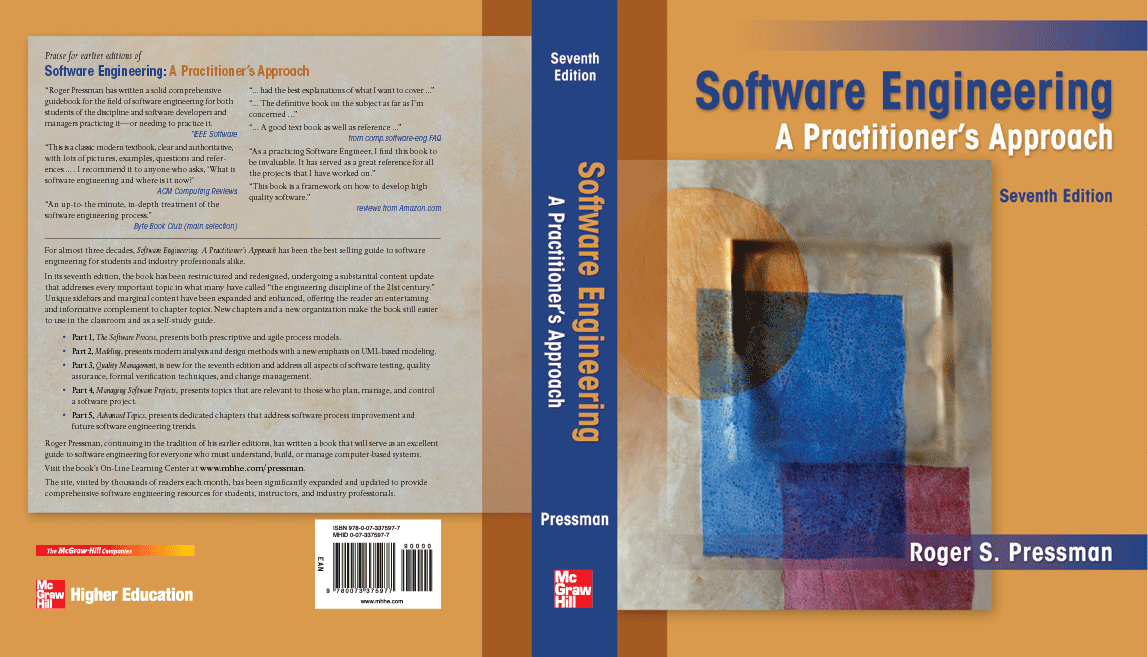
The seventh edition of Software Engineering: A Practitioner's Approach is intended to serve as a guide to a maturing engineering discipline. The seventh edition, like the six editions that preceded it, is intended for both students and practitioners, retaining its appeal as a guide to the industry professional and a comprehensive introduction to the student at the upper level undergraduate or first year graduate level.

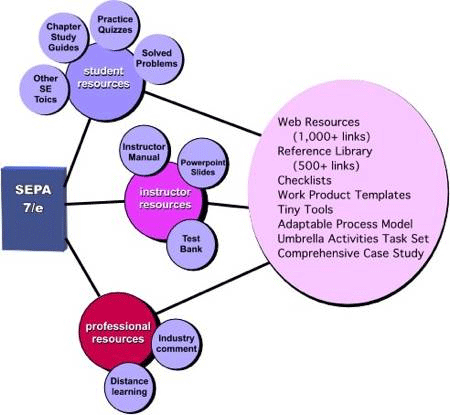
The seventh edition is considerably more than a simple update. The book has been revised and restructured to improve pedagogical flow and emphasize new and important software engineering processes and practices. In addition, a revised and updated “support system,” illustrated below, provides a comprehensive set of student, instructor, and professional resources to complement the content of the book.

lakshmi menon fake nude images
The 32 chapters of the seventh edition have been reorganized into five parts. This organization, which differs considerably from the sixth edition, has been done to better compartmentalize topics and assist instructors who may not have the time to complete the entire book in one term.

Part 1, The Process, presents a variety of different views of software process, considering all important process models and addressing the debate between prescriptive and agile process philosophies. Part 2, Modeling, presents analysis and design methods with an emphasis on object-oriented techniques and UML modeling. Pattern-based design and design for Web applications are also considered. Part 3, Quality Management, presents the concepts, procedures, techniques, and methods that enable a software team to assess software quality, review software engineering work products, conduct SQA procedures, and apply an effective testing strategy and tactics. In addition, formal modeling and verification methods are also considered. Part 4, Managing Software Projects, presents topics that are relevant to those who plan, manage, and control a software development project. Part 5, Advanced Topics, considers software process improvement and software engineering trends. Continuing in the tradition of past editions, a series of sidebars is used throughout the book to present the trials and tribulations of a (fictional) software team and to provide supplementary materials about methods and tools that are relevant to chapter topics. Two new appendices provide brief tutorials on UML and object-oriented thinking for those who may be unfamiliar with these important topics.

The five-part organization of the seventh edition enables an instructor to "cluster" topics based on available time and student need. An entire one-term course can be built around one or more of the five parts. A software engineering survey course would select chapters from all five parts. A software engineering course that emphasizes analysis and design would select topics from Parts 1 and 2. A testing-oriented software engineering course would select topics from Parts 1 and 3, with a brief foray into Part 2. A "management course" would stress Parts 1 and 4. By organizing the seventh edition in this way, I have attempted to provide an instructor with a number of teaching options.
Software Engineering: A Practitioner's Approach
7th Edition
Table of Contents

Chapters

1. Software and Software Engineering

Part I - Process

2. Process Models
3. Agile Development

Part II - Modeling

4. Practice: A Generic View
5. Understanding Requirements (new chapter)
6. Requirements Modeling: Scenarios and Data (new chapter)
7. Requirements Modeling: Flow, Classes, and Behavior (new chapter)
8. Design Concepts (new chapter)
9. Architectural Design
10. Component-Level Design
11. Usability design (new chapter)
12. Pattern-based Design (new chapter)
13. WebApp Design

Part III - Quality Management

14. Quality Concepts (new chapter)
15. Software reviews (new chapter)
16. Software Quality Assurance
17. Software Testing Strategies
18. Testing Methods for Conventional Software (new chapter)
19. Testing Methods for OO Software (new chapter)
20. Testing Methods for WebApps
21. Advanced Verification Methods (new chapter)
22. Software Configuration Management
23. Product Metrics

Part IV - Project Management

24. Management Concepts
25. Process and Project Metrics
26. Estimation
27. Scheduling
28. Risk Management
29. Maintenance and Reengineering (new chapter)

Part V-Advanced Topics

30. Software Process improvement (new chapter)
31. Emerging Trends in Software Engineering (new chapter)
32. The Road Ahead
Appendix I - UML Tutorial (new)
Appendix II - OO Concepts (new)


Home About us Products Product Models SE Resources Commentary Contact us
Web site and all contents © 2001-2009, R.S. Pressman & Associates, Inc., All rights reserved.
Free website templates